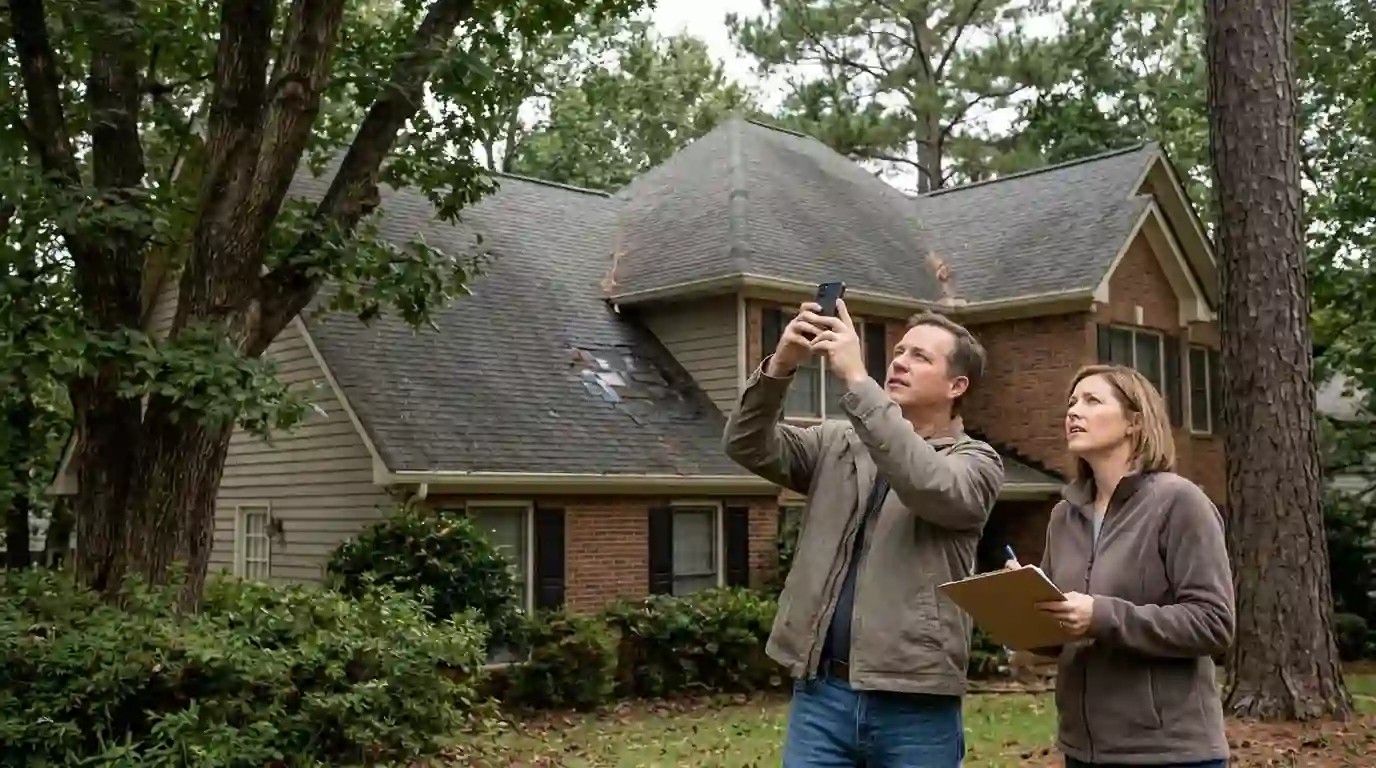
Document the damage with dated photos, protect the house from more water, then call your insurer to open a claim. An adjuster inspects the roof and writes a scope with a dollar amount. You pay your deductible, and many policies hold back some depreciation until the work is done. We are roofers, not public adjusters, so we can inspect, document and explain, but the insurer makes the decision.
Step one: document the damage and stop more water
After a hailstorm or a tree limb comes down, the first job is a clear record. Take dated photos and video from the ground of the roof, the gutters, the siding, window screens and any dented metal like downspouts or the AC unit. Hail marks on soft metal help show the size of the stones. Inside, photograph stains on ceilings, wet insulation and anything damaged. Write down the date and rough time of the storm while you remember it, since the insurer will ask. Local news reports and weather service hail maps for that day are worth saving too.
Then limit the damage. Most policies expect you to take reasonable steps to prevent further loss, such as a tarp over an opening or buckets under a drip. Keep receipts for tarps, emergency service and anything you buy, because those costs are often part of the claim. Do not climb a wet or steep roof yourself. If water is coming in, call us any hour and we can tarp the roof and photograph what we find while we are up there. Those roof photos show damage you cannot see from the yard, and they become part of your record.
- Outside photos. Wide shots of every side of the house, then close-ups of gutters, downspouts, vents, screens and fences. Dented soft metal is useful evidence of hail size and direction.
- Inside photos. Ceiling stains, wet drywall, damp insulation in the attic and any damaged belongings. Take pictures before you clean up or move anything out of the way.
Step two: call your insurer and open the claim
Call the number on your policy or use your carrier's app to report the loss. You will get a claim number; write it down and use it every time you call. Ask a few practical questions up front: what your deductible is for wind and hail, if your policy pays replacement cost or actual cash value on the roof, and if there is a deadline for reporting damage or finishing repairs. Policies differ, so the answers for your neighbor may not match yours. Keep a simple log of every call: the date, the name the representative gives you and what was said. That log saves real frustration later if details get lost between departments.
Many homeowners like to have a roofer inspect before or right after they call the insurer, just to know whether the damage is worth a claim. That is a reasonable step. We can tell you what we see, show you photos and say plainly when damage looks minor or older than the storm. Filing a claim for wear and tear usually ends in a denial, so it helps to know what you are dealing with first. A denied claim still sits in your claim history, which is one more reason to get an honest look before you call.
Step three: the adjuster visit
The insurer will send an adjuster, sometimes a staff adjuster and sometimes an independent one hired after a large storm. After a big hail day in the metro, it can take a while to get on the schedule. The adjuster walks the roof, counts hits in test squares on each slope, looks at soft metal and vents, and checks the inside damage. Be home for the visit if you can, and have your photos and receipts ready. Show the adjuster any inside damage, and mention anything you noticed during the storm, like a sudden drip or a loud strike on one side of the house.
You can ask your roofer to be there during the inspection. When we meet an adjuster, our role is simple: point out what we found, answer questions about how the roof is built and note items like drip edge, pipe boots or decking that may be affected. We do not negotiate the claim on your behalf. In Georgia that kind of advocacy is the work of a public adjuster or an attorney, and we stay in our lane as the roofer. Our job is accurate facts about the roof, not arguing the policy.
Step four: reading the scope and the payment
After the visit, the insurer sends a written estimate, often called the scope. It lists each item with a quantity and price: tear-off, shingles by the square, underlayment, starter, ridge cap, flashing, vents and so on. Read it slowly, side by side with your own roofer's estimate. If something is missing, such as a code item or the second layer of shingles that has to come off, your roofer can document it with photos and measurements so you can ask the insurer to take another look at those specific items.
The scope also shows how the payment works. Replacement cost value is what the work should cost today. Depreciation is an amount subtracted for the age and wear of the old roof. Actual cash value is what remains after depreciation and your deductible. On many policies, the first check is the actual cash value, and the rest comes later. For example, on a replacement cost policy the insurer might hold back the depreciation until the new roof is installed. On an actual cash value policy, the depreciation may never be paid at all. Your declarations page and roof endorsements spell out which type you have.
- Replacement cost value. The insurer's estimate of what it costs to repair or replace the damaged roof today with similar materials, before anything is subtracted for age or deductible.
- Depreciation. The amount taken off for the age and condition of the old roof. On some policies part of it is recoverable once the work is finished and documented.
- Actual cash value. Replacement cost minus depreciation and your deductible. On many replacement cost policies this is the first payment you receive after the adjuster's scope is approved.
Step five: deductible, recoverable depreciation and the work
Your deductible is your responsibility, and paying it is part of the deal you made with your insurer. Be wary of any contractor who offers to waive it, absorb it or hide it inside the estimate. That practice can be treated as insurance fraud, and it puts the homeowner at risk too. A fair roofer prices the job honestly and lets the claim and the deductible work the way the policy says. If the deductible is a strain, ask your agent about payment timing, or ask us about phasing optional upgrades so the core repair still gets done right.
If your policy includes recoverable depreciation, the insurer usually releases the held-back amount after the roof is replaced and you send proof, such as a final invoice and photos. Watch the time limit for claiming it. Some mortgage companies also put their name on the check and need to endorse it. We cannot promise what any insurer will pay, but we can explain the paperwork and do the roof right. If questions come up along the way, call us and we will walk through the scope with you line by line.