Flashing Repair in Atlanta, GA
Leaks that show up where a roof meets a wall, a dormer or a second-story section almost always come from flashing that has rusted, slipped or was only caulked in place.
- Phones answered 24/7 at (470) 876-1496
- Photos of every problem spot before any work
- Line-item written scope
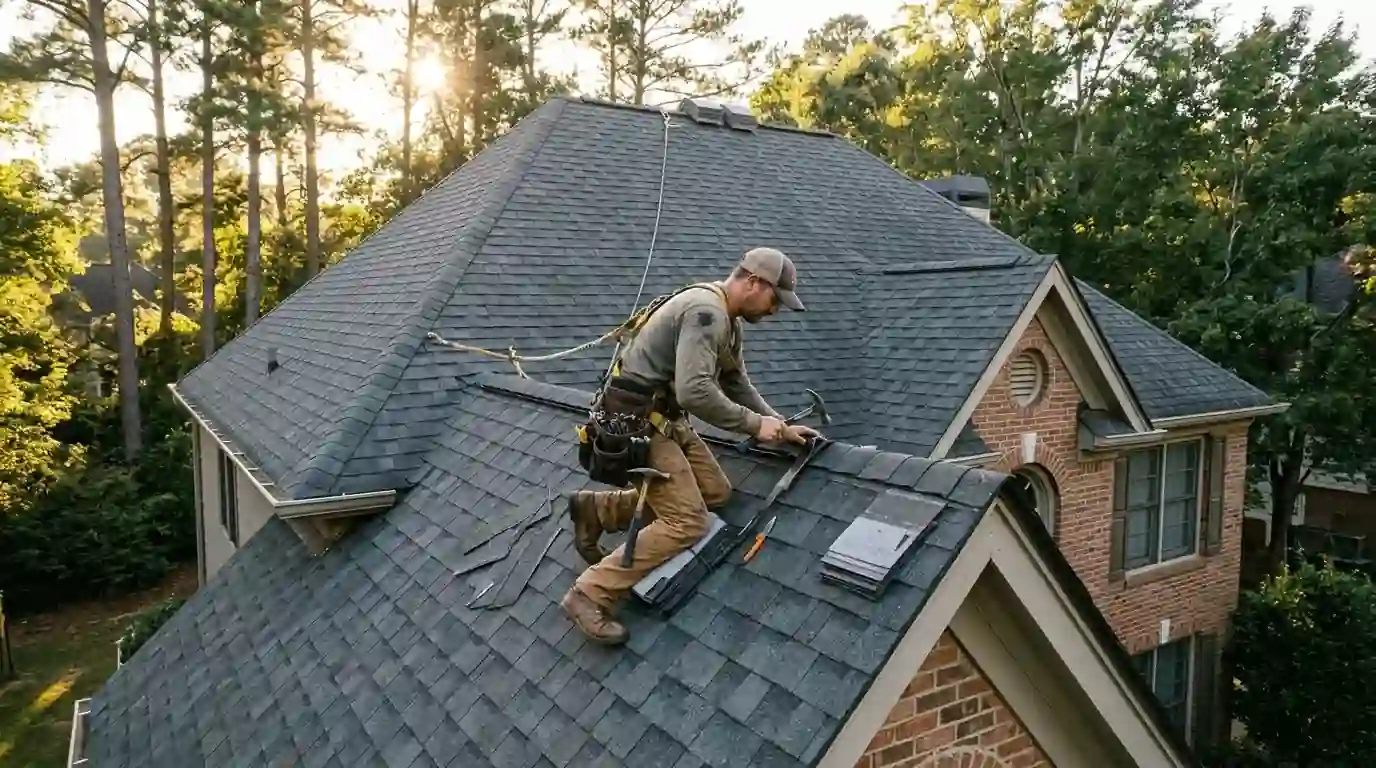
Flashing repair is replacing or rebuilding the metal pieces that seal joints where the roof meets walls, dormers, chimneys and edges. In Atlanta you need it when stains appear along interior walls below a roofline, when caulk at a sidewall has cracked, or when step flashing has rusted out on an older home. Typical flashing repairs run about $415 to $1,380 per area based on length, siding type and access.
Shingles do most of the work on a roof, but they cannot seal a joint where two surfaces meet. That job belongs to flashing: bent pieces of aluminum, galvanized steel or copper layered so water always runs over a lap and never behind it. Step flashing climbs a sidewall in short overlapping pieces, one per shingle course. Headwall flashing caps the top of a slope where it meets a wall. Kickout flashing at the bottom of a wall turns water into the gutter instead of letting it run down behind the siding. When any of those pieces is missing or installed out of order, water finds the gap.
A lot of the flashing problems we find in Atlanta are not old age. They are shortcuts. A roofer reused rusty step flashing during a past reroof, or skipped kickout flashing entirely, or ran a bead of caulk along a wall instead of tucking metal behind the siding. Those shortcuts can hold for a few years, then start leaking into the wall cavity where nobody sees it until the drywall or trim rots. Proper flashing repair means removing shingles and sometimes a course or two of siding, then installing new metal in the right sequence.
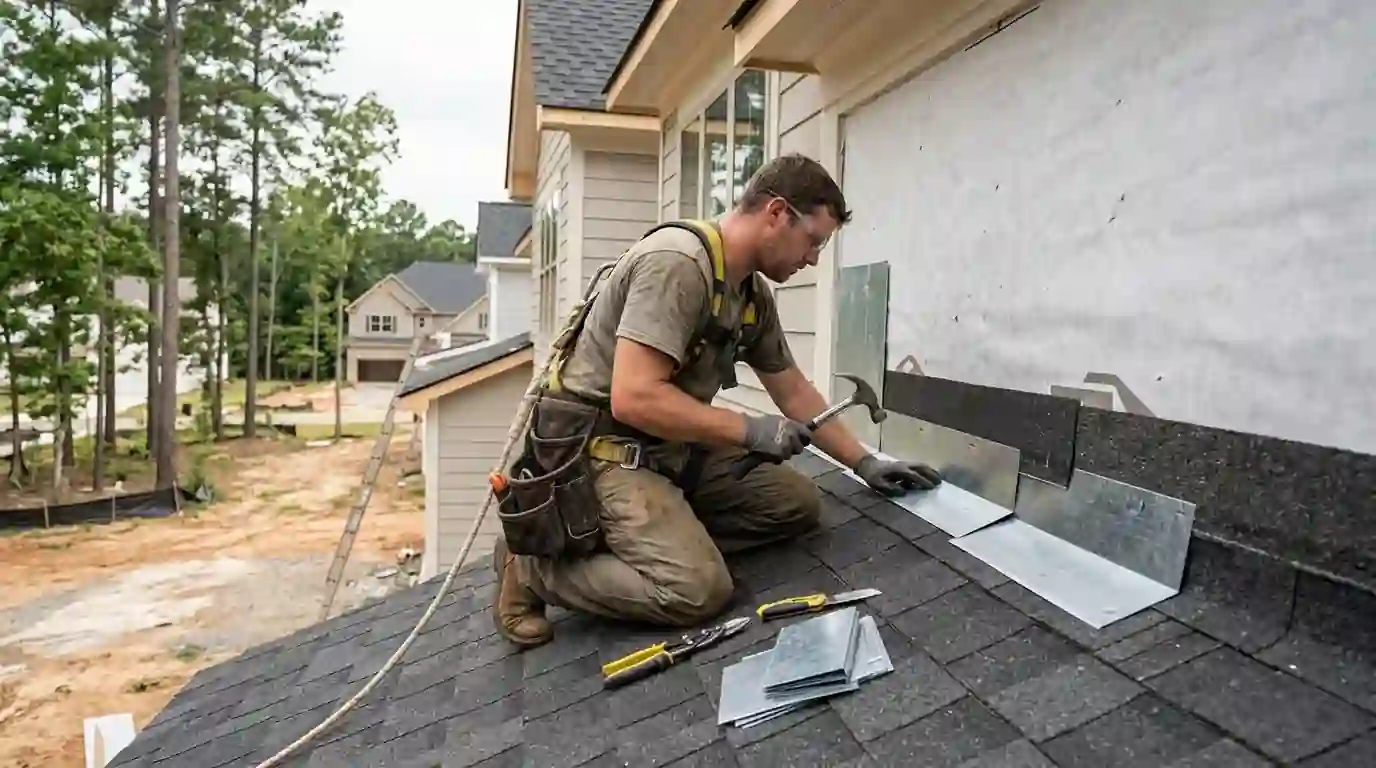
Flashing Repair on a metro Atlanta home.
Types of flashing we repair and replace
Step flashing
Short L-shaped pieces woven into each shingle course along a sidewall. We replace the full run instead of patching one piece, since old pieces rarely line up with new ones and the run must lap correctly.
Kickout flashing
A small angled piece at the bottom of a roof-to-wall joint that throws water into the gutter. Many Atlanta homes built before the 2000s are missing it, and adding one stops a lot of siding rot.
Headwall and apron flashing
Where the top of a slope runs into a wall, a long bent piece laps over the shingles and tucks behind the siding. We replace bent or rusted headwall metal and seal it properly.
Drip edge and rake metal
Metal along eaves and rakes guides water off the roof and protects the deck edge. We replace damaged sections or add drip edge where it was never installed on older roofs.
What flashing repair costs in metro Atlanta
Length of the joint
A short dormer cheek takes less time and metal than a long sidewall running the length of a garage roof into a two-story wall.
Siding type
Vinyl siding comes off and back on easily. Fiber cement, stucco, brick and stone take more care, and sometimes need a separate trade to patch.
Hidden rot
Long-running flashing leaks often rot wall sheathing and roof deck. Replacing those boards adds cost but stops the leak from coming back.
Flashing metal
Prefinished aluminum and galvanized steel are standard. Copper costs more but lasts longer and suits historic homes or high-end exteriors.
Roof access
Joints high on a second-story roof, or over a deck or sunroom, need more setup and protection than a low, walkable porch roof.
These are typical ranges from recent Atlanta-area jobs, not a quote. See every service side by side on our roof prices page, or call (470) 876-1496 for a visit.
We install and repair shingles from GAF, Owens Corning, CertainTeed and Atlas, metal panels from Englert, membranes from Carlisle and skylights from Velux, matched to the roof already on your house.
How we rebuild flashing the right way
Locate the failing joint
We check inside and on the roof to confirm which wall, dormer or edge is leaking, and look at the siding type to plan how much needs removing.
Remove shingles and siding
We carefully lift the shingles along the joint and, when needed, remove the lowest courses of siding or trim so we can reach the full height of the flashing.
Inspect sheathing and framing
With the joint open, we check the roof deck and the wall sheathing for rot. Any damaged wood is cut out and replaced before new metal goes in.
Install underlayment and metal
We add self-adhering membrane up the wall, then install new step flashing one piece per course, with headwall and kickout pieces placed in the correct order.
Replace shingles and siding
Shingles are woven back over the step flashing, and siding or trim goes back over the vertical legs so water always runs over the metal, never behind it.
Seal exposed edges and test
We seal nail heads and exposed edges, then test with a hose when practical. You get photos of the new flashing before it disappears behind the siding.
Why flashing fails on so many Atlanta homes
Many suburban two-stories built across north Fulton, Gwinnett and Cobb in the 1990s and 2000s have busy rooflines: front gables, garage roofs tied into second-story walls, dormers and bump-outs. Each one of those intersections depends on flashing, and many were built quickly during housing booms with minimal kickout or step flashing. Hard-driving summer storms then push water against those joints from the side, which is exactly when weak flashing leaks. Our humidity keeps wall cavities damp once water gets in, so rot spreads quietly behind vinyl and fiber cement siding. On older intown homes, galvanized flashing from past reroofs has often rusted thin, and layers of caulk hide the problem until stains appear inside.
We serve the whole metro from our Alpharetta office, so north Fulton, Forsyth and east Cobb calls are usually the quickest to schedule.
Is failed flashing behind the leak along your wall?
Stains along an inside wall
Water marks running down an interior wall below where a lower roof meets a second story point straight at step or headwall flashing on that joint.
Rotted siding at a roof corner
Soft or swollen siding where a roof edge meets a wall often means kickout flashing is missing, so water is running behind the siding every rain.
Caulk instead of metal
If all you see along a wall joint is a thick bead of caulk with no metal visible, the joint relies on sealant alone. It will crack and leak eventually.
Rust streaks on the roof
Orange streaks running down shingles below a wall or vent show old galvanized flashing rusting through. Thin spots will soon become holes that let water in.
Loose metal along edges
Drip edge or apron flashing that is bent, lifted or rattling in wind may have lost its fasteners and can let wind-driven rain blow under shingles.
Leaks after siding work
When leaks start after new siding or paint, the siding crew may have disturbed or covered flashing. It is worth checking the joint before damage spreads.
Flashing Repair across the Atlanta metro
These are the largest places we cover. Every one of our 71 service areas gets the same service.
- Atlanta 30305
- Sandy Springs 30328
- Roswell 30075
- Johns Creek 30022
- Alpharetta 30004
- Marietta 30060
- Smyrna 30080
- Dunwoody 30338
- Brookhaven 30319
- Duluth 30096
- Lawrenceville 30043
- Kennesaw 30144
- Peachtree Corners 30092
- Decatur 30030
- Milton 30004
- Woodstock 30188
- Cumming 30028
- Stockbridge 30281
- McDonough 30252
- Douglasville 30134
Flashing Repair questions from Atlanta homeowners
Can flashing repair be done without removing my siding?
Sometimes, but not often if the job is done right. Step and headwall flashing should tuck behind the siding so water runs over it. To reach it, we remove the lowest course or two of siding or trim, then reinstall it. On vinyl, that is quick and clean. On brick, stone or stucco, we may cut a small reglet or use counter flashing instead.
What is kickout flashing and does my house need it?
Kickout flashing is a small angled piece at the bottom of a roof-to-wall joint that diverts water into the gutter. Without it, water running down the step flashing pours behind the siding at the corner. If your home has a roof edge that dies into a wall, it likely needs one. It is a small part that prevents a lot of rot.
Why not just caulk the flashing along my wall?
Caulk can be part of a flashing detail, but it should never be the only thing keeping water out. Sealants shrink, crack and pull away under Georgia heat and UV, often within a few years. Lapped metal works by gravity and keeps working when sealant fails. We use caulk at exposed edges and fasteners, with metal doing the real work.
How long does a sidewall flashing repair take on a two-story home?
Most sidewall flashing repairs take a few hours to a full day. A short dormer wall is quick. A long run where a garage roof meets a two-story wall takes longer, especially when siding must come off and rotted sheathing needs replacing. We give you a time estimate with the price so you can plan around it.
Services that often go with this one
Chimney Flashing Repair
Chimney flashing repair with new step, counter and cricket flashing that keeps water out of the joint between brick and roof.
Learn more ›Roof Leak Repair
Roof leak repair that traces the water back to where it really gets in, then fixes that spot for good.
Learn more ›Drip Edge Installation
Metal drip edge along eaves and rakes that steers runoff into the gutter and keeps water off your fascia and roof deck.
Learn more ›Need flashing repair in Atlanta?
Call (470) 876-1496. A person answers 24/7 and a roofer from our Alpharetta office follows up with a visit and photos.