Roof Valley Repair in Atlanta, GA
Valleys carry more water than any other part of the roof, so when one wears thin, clogs with pine straw or was cut wrong, leaks follow every heavy rain.
- Phones answered 24/7 at (470) 876-1496
- Photos of every problem spot before any work
- Line-item written scope
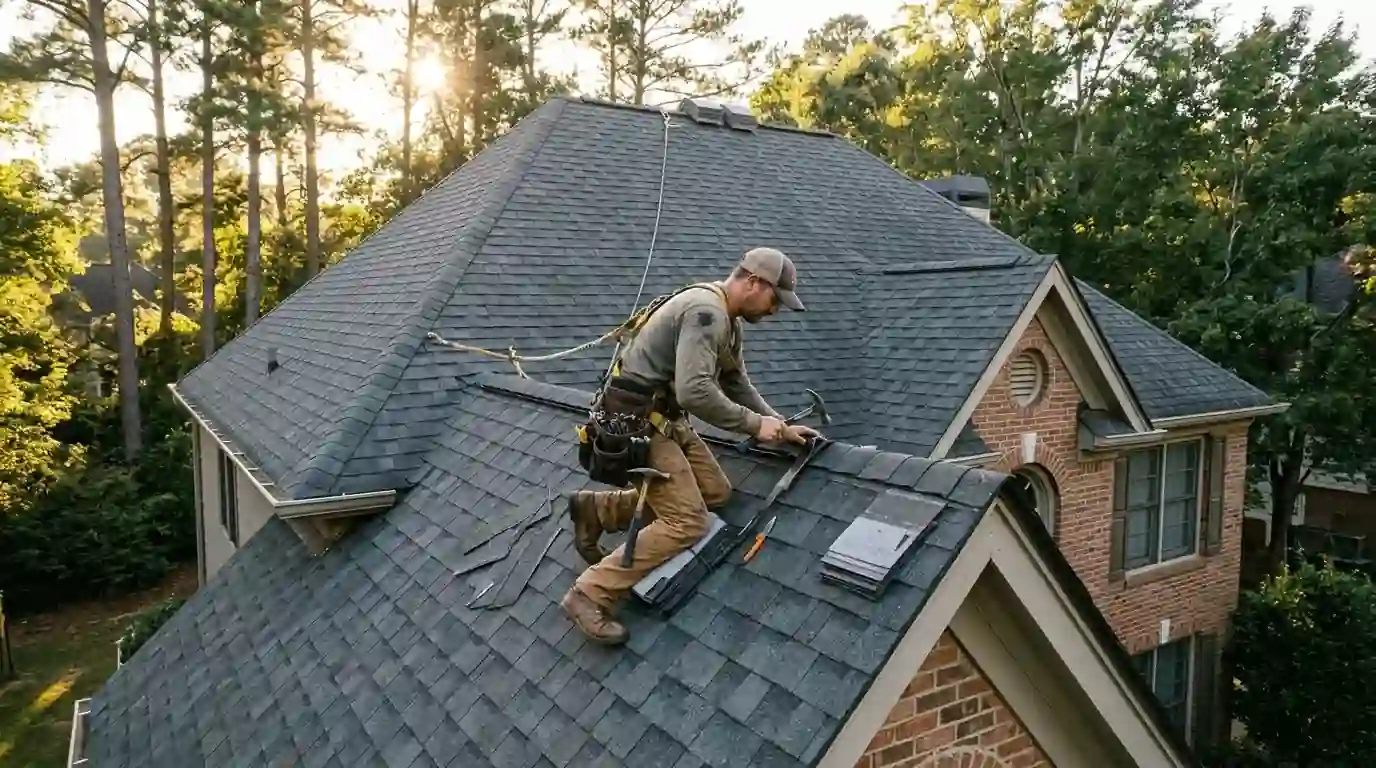
Roof valley repair means rebuilding the channel where two roof slopes meet, replacing worn shingles, underlayment and sometimes metal so water flows off cleanly. In Atlanta you need it when leaks appear under a valley after hard storms, when debris keeps piling up, or when the shingles in the valley have worn down to the mat. Most valley repairs run about $685 to $2,340 based on length, pitch and valley style.
Think about how much water lands on two large roof slopes in a ten-minute summer downpour, then picture all of it squeezed into one narrow channel. That is the job of a valley. It handles concentrated, fast-moving water every storm, along with whatever pine needles, oak leaves and seed pods wash down with it. Shingles in a valley wear faster than anywhere else, and any flaw in how the valley was built, such as nails too close to the center or a cut line that traps water, shows up as a leak sooner or later.
We repair valleys by removing shingles on both sides, replacing the underlayment with self-adhering valley membrane, and rebuilding the valley in a style suited to your roof. Some roofs get an open metal valley that sheds debris and water quickly. Others get a closed-cut valley, where one slope's shingles run through and the other side is trimmed cleanly along a chalk line. We also look at why the valley failed. If an upper roof dumps water into it, or overhanging trees keep loading it, we talk about diverters, trimming or gutter changes so the new valley lasts.
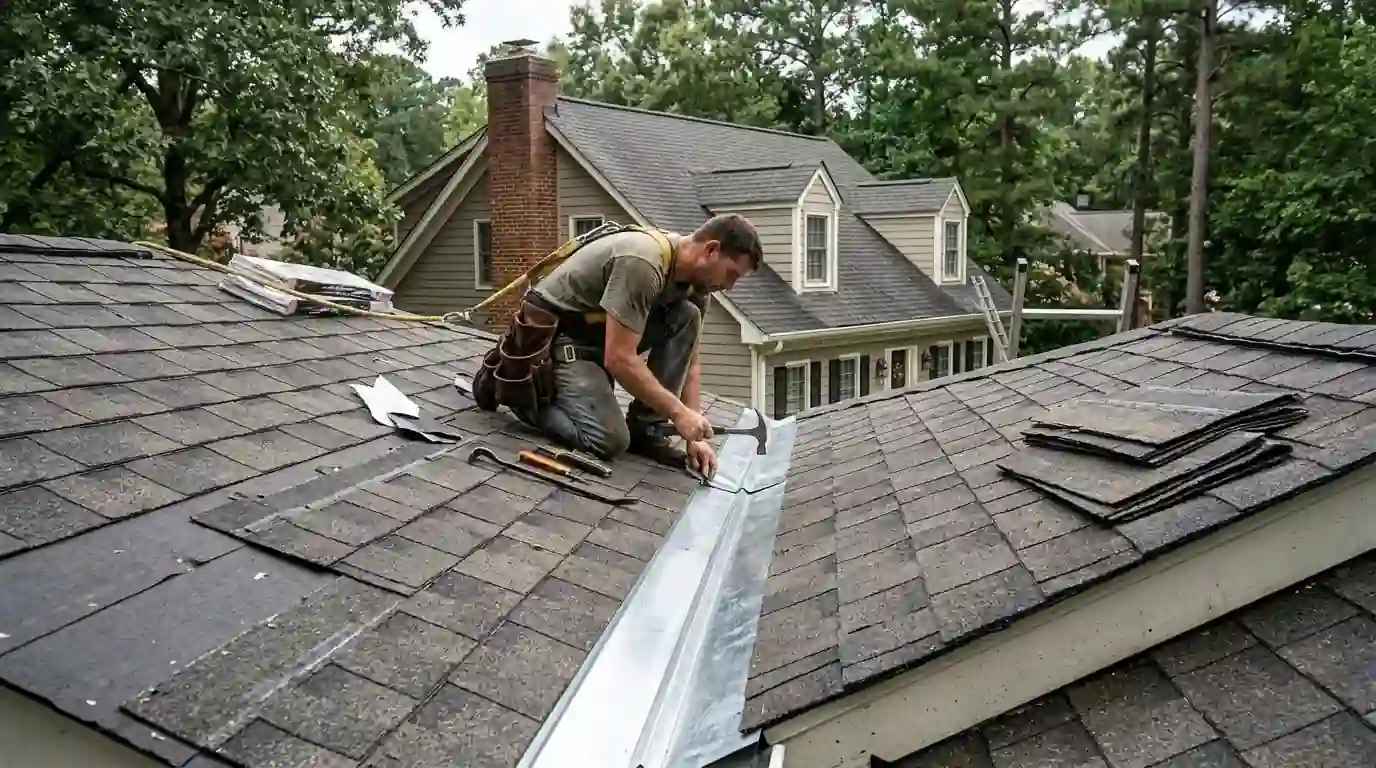
Roof Valley Repair on a metro Atlanta home.
Valley styles and when each one fits
Open metal valley
A W-shaped or plain metal channel left exposed down the center. It sheds water and debris quickly, which suits wooded Atlanta lots. Prefinished aluminum or steel blends with the roof, and copper adds a striking accent.
Closed-cut valley
Shingles from one slope run across the valley, and shingles from the other side are trimmed along a straight line. It gives a clean look and is common on architectural shingle roofs across the metro.
Woven valley
Shingles from both slopes interlock across the valley. It works well with three-tab shingles and gentle pitches, but laminated shingles are too thick to weave neatly, so we rarely recommend it on newer roofs.
Valley with debris diverter
Where an upper roof or a tall pine keeps loading a valley, a small diverter or a cricket upslope can split the flow. It is a modest add-on that eases pressure on the repaired valley.
What roof valley repair costs in metro Atlanta
Valley length
A short valley over a front porch is a small job. A long valley between two main roof planes on a two-story home takes more material and time.
Roof pitch
Steep valleys are slower and need more safety setup. Valleys on steep Victorian or modern farmhouse roofs cost more than those on gentle ranch roofs.
Valley style chosen
Closed-cut shingle valleys use materials you already have. Open metal valleys add the cost of prefinished or copper metal but shed debris better.
Deck condition
Valleys that have leaked for years often have rotted sheathing along the center. Replacing it adds cost but gives the new valley a solid base.
Shingle blending
Removing shingles on two slopes means more new shingles to blend in. Discontinued colors can add time to source the best available option.
These are typical ranges from recent Atlanta-area jobs, not a quote. See every service side by side on our roof prices page, or call (470) 876-1496 for a visit.
We install and repair shingles from GAF, Owens Corning, CertainTeed and Atlas, metal panels from Englert, membranes from Carlisle and skylights from Velux, matched to the roof already on your house.
How we rebuild a leaking roof valley
Inspect the full valley
We check the valley from top to bottom, plus the attic below it, to see how far the damage runs and whether the decking has softened along the center line.
Remove shingles on both sides
Shingles are carefully removed a couple of feet out from the center on each slope, so we can replace the underlayment across the full width of the valley.
Repair the decking
Any soft or delaminated plywood or OSB along the valley is cut out and replaced with new sheathing, fastened to the rafters so the valley stays flat and true.
Install valley membrane
We run self-adhering ice and water membrane down the center, lapping it properly, so even if water gets past the shingles, it cannot reach the deck.
Rebuild the valley surface
We install open metal, closed-cut or woven shingles, keeping nails well away from the center and trimming cut lines with a clipped top corner to steer water.
Clear and check drainage
We clean the gutter below, make sure the valley drains freely into it, and point out any trees or upper roofs that will keep loading the valley with debris.
What Atlanta's trees and storms do to roof valleys
Few cities have tree cover like Atlanta, and valleys feel it the most. Loblolly pines drop needles year round, and oaks add leaves, catkins and acorns in spring and fall. All of it slides downhill into valleys, where it packs into a wet mat that holds water against the shingles. Then a summer thunderstorm sends a burst of runoff down the same channel, and any weak spot lets water in. Complex roofs on homes in Alpharetta, Johns Creek, Suwanee and East Cobb often have several valleys feeding into one another, so a single failed valley can affect a large section of ceiling. Clearing valleys regularly and rebuilding worn ones with proper membrane makes a real difference here.
If you are comparing scopes from more than one roofer, ask each for the same line items: underlayment, flashing, vents, decking allowance and disposal. It makes the numbers comparable.
Is your roof valley the source of the leak?
Leak below where slopes meet
A stain on a ceiling under the line where two roof planes join is the classic valley leak. It often shows up only in heavy or long storms.
Debris piling in the valley
Pine straw, leaves and seed pods that sit in a valley act like a dam. Water backs up under the shingle edges and finds nail holes.
Worn shingles down the center
Shingles in the valley that look smooth, dark or bare have lost their granules to the constant water flow. The asphalt mat underneath wears out fast.
Cracked or lifted cut edge
On closed-cut valleys, the trimmed edge should lie flat. A cracked or curled cut line lets water slip underneath and run sideways toward the deck below.
Rusted or bent valley metal
Old galvanized valley metal can rust through, and dents from falling limbs can create low spots where water sits and seeps under the shingle edges with each rain.
Overflowing gutter at the base
When the gutter below a valley overflows every storm, water may be backing up onto the lower shingles and under them. It is worth checking both.
Roof Valley Repair across the Atlanta metro
These are the largest places we cover. Every one of our 71 service areas gets the same service.
- Atlanta 30305
- Sandy Springs 30328
- Roswell 30075
- Johns Creek 30022
- Alpharetta 30004
- Marietta 30060
- Smyrna 30080
- Dunwoody 30338
- Brookhaven 30319
- Duluth 30096
- Lawrenceville 30043
- Kennesaw 30144
- Peachtree Corners 30092
- Decatur 30030
- Milton 30004
- Woodstock 30188
- Cumming 30028
- Stockbridge 30281
- McDonough 30252
- Douglasville 30134
Roof Valley Repair questions from Atlanta homeowners
Is a metal valley or shingle valley better for a roof under pine trees?
For roofs under heavy pine and oak cover, we usually lean toward open metal valleys. The smooth metal lets needles and leaves slide off faster, and there are no shingle edges in the center for debris to catch on. Closed-cut shingle valleys work well too, especially on more open lots, but they benefit from more frequent cleaning when trees overhang.
How long does a roof valley repair take on a two-story Alpharetta home?
Most single valley repairs take about half a day to a full day. A long valley between two main roof planes on a steep two-story home can take longer because of safety setup and the amount of shingle work on both slopes. If decking along the valley is rotted, that adds a few hours. We give you a time estimate with the price.
Can a leaking roof valley be patched instead of rebuilt?
A small cracked shingle or a single nail pop in a valley can sometimes be patched. But when valley shingles are worn thin or the underlayment has failed, patching only buys a little time. Because valleys carry so much water, we usually recommend rebuilding the full valley with new membrane so the repair holds through many storms.
How often should I clean debris out of my roof valleys?
On wooded Atlanta lots, checking valleys at least twice a year, typically late spring after pollen and catkins fall and late fall after leaves drop, works for most homes. Under heavy pine cover, some valleys need attention more often. Avoid pressure washing them. Gentle clearing by hand or with a leaf blower protects the shingles.
Services that often go with this one
Roof Leak Repair
Roof leak repair that traces the water back to where it really gets in, then fixes that spot for good.
Learn more ›Gutter Guards
Gutter guards that keep pine needles, oak leaves and seed pods out so your gutters keep flowing through every season.
Learn more ›Roof Maintenance Plans
Yearly or twice-yearly roof checkups with minor sealing, debris clearing and gutter care to stretch the life of your roof.
Learn more ›Need roof valley repair in Atlanta?
Call (470) 876-1496. A person answers 24/7 and a roofer from our Alpharetta office follows up with a visit and photos.