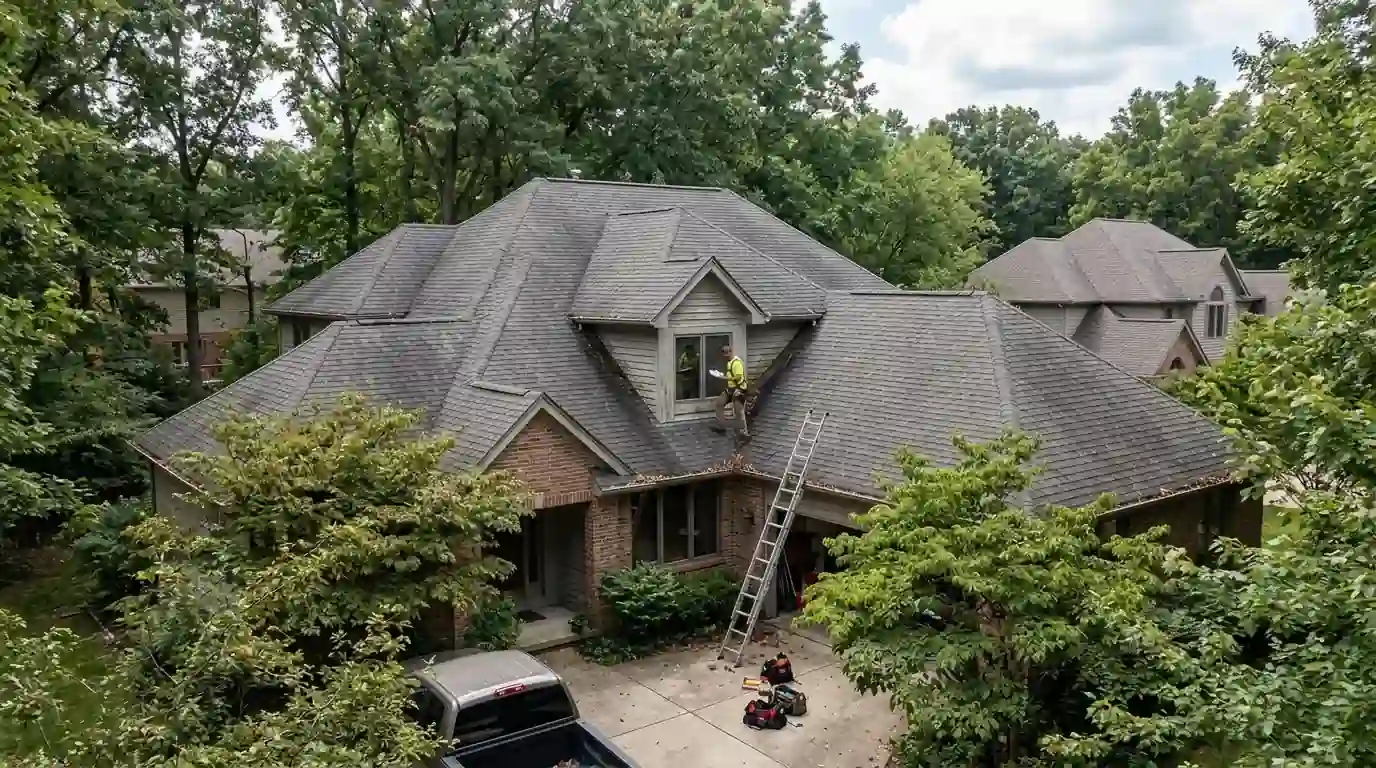
Trees mostly hurt roofs slowly. Pine needles pile up in valleys and gutters and hold water, branches scrape shingles, and shade keeps the roof damp so algae and moss grow. Keep limbs about 6 to 10 feet off the roof, clear valleys at least twice a year, and call a qualified arborist for any large limb over the house or near power lines.
Why pine needles in valleys cause leaks
Loblolly and other pines shed needles almost all year, with heavy drops in fall and again after big storms. On a roof, the needles slide down until they hit something, and the first stop is usually a valley, the inside corner where two slopes meet. Every valley carries water from two roof planes, so it already works harder than the rest of the roof. When a thick mat of needles builds up there, it acts like a dam and a sponge at the same time, slowing the water and holding it against the shingles.
Over time that trapped water finds its way under the shingle edges, especially during the long, heavy rains we get in summer thunderstorms. The needles also hold moisture against the granules and feed rot in the decking below. Behind chimneys and against sidewalls, needle piles do the same thing to flashing. Many of the valley and chimney leaks we repair on wooded lots around Sandy Springs, Roswell and Decatur start exactly this way, with a roof that is otherwise in decent shape. Clearing the valleys costs far less than replacing wet decking.
Limb clearance and branch rub
Branches touching the roof do damage you may not notice for years. Every breeze drags the limb back and forth across the shingles, grinding off granules and eventually wearing through to the mat. Overhanging limbs also drop a steady supply of twigs, acorns and needles, and they give squirrels an easy bridge to your fascia, soffit vents and attic. A gap of open air around the roof solves most of these problems at once. It also lets sun and breeze reach the shingles, so they dry faster after rain and grow less algae.
The bigger risk is a limb or whole tree coming down. Atlanta gets strong summer storms, occasional ice storms and the remnants of tropical systems, and a heavy oak limb can break rafters as well as shingles. Dead limbs, cracked trunks and trees that lean toward the house are worth a professional opinion before the next storm, not after it. Water oaks and older pines near the house deserve extra attention, because they often decline from the inside before the outside shows much. A quick walk around your trees each spring, looking up at the canopy, is time well spent.
- Clearance target. Keep branches roughly 6 to 10 feet away from the roof surface and chimney, so they cannot rub in wind and squirrels cannot jump from limb to shingle.
- Overhanging limbs. Thinning or shortening limbs over the house cuts debris and shade. Large limbs above the roof should be lowered with ropes by an arborist, not dropped.
- Warning signs. Dead branches, fungus at the base, deep cracks, peeling bark or a new lean toward the house all point to a tree that needs an expert look soon.
Sap, shade and the black streaks
Pine sap on shingles looks alarming but usually does little harm by itself. The problem is that sticky spots catch needles, pollen and dirt and hold them in place. Do not scrape or pressure wash sap off asphalt shingles, since that strips granules faster than the sap ever would. If a spot really bothers you, let us look at it; often the best move is to leave it and deal with the debris around it. Sap on gutters, skylights and siding can usually be softened with a mild cleaner and wiped off by hand without harm.
Shade is the bigger issue. Roofs under a heavy canopy stay damp for hours after rain or morning dew, and that is ideal for algae, moss and lichen. The black streaks you see on many north-facing Atlanta roofs are algae, often a strain called Gloeocapsa magma. It looks bad but does not cause leaks quickly. Over many years, though, it can hold moisture and shorten the roof's life a little. Moss is different: it holds water like a sponge and lifts shingle edges, so it needs attention sooner. Algae-resistant shingles with copper-coated granules are worth asking about when the roof is replaced.
- Algae streaks. Mostly cosmetic. A gentle low-pressure cleaning with a roof-safe solution removes it, and zinc or copper strips near the ridge help slow regrowth.
- Moss and lichen. Holds moisture and pries up shingle edges. It should be treated and removed carefully, then the shade that caused it reduced where possible.
- Sap spots. Usually harmless on their own. Leave them alone rather than scrape, and keep the needles and debris that stick to them cleared away.
What to trim, and when
Small branches you can reach from the ground with a pole saw are fair game for a careful homeowner, as long as they are well away from wires and nothing will fall on the roof. Anything bigger, anything that has to be cut from a ladder, and anything over the house belongs to a professional. A falling limb can crack a shingle, dent a gutter or punch through decking, and the person cutting it is in real danger too. Please do not stand on the roof to saw limbs; it is one of the more common ways homeowners get hurt.
Timing matters for tree health as well as convenience. Many arborists prefer late fall through winter for major pruning of oaks and other hardwoods, when the trees are dormant and pests are less active. Pines can be sensitive to heavy cuts in hot weather, when stressed trees may draw bark beetles. A good arborist will tell you what fits your trees and your property. Dead or hazardous limbs are the exception: those should come down as soon as they are spotted, in any season, before a storm brings them down for you.
When to call an arborist, and when to call us
Call a qualified arborist for any tree that is dead, damaged, leaning, close to power lines or hanging large limbs over the house. If power lines run through the tree, the utility company handles the work near those lines. A good tree service carries the right equipment, uses rigging to lower heavy wood and can tell you whether a tree can be saved with pruning or should come down. Ask for a written plan so you know which limbs will be cut and how the wood will be lowered near the roof.
Call us when the roof itself needs attention: needle mats in the valleys, worn spots where limbs have rubbed, moss, clogged gutters or any sign of a leak. After a limb falls on the roof, we can tarp and assess the damage the same day, any hour. We also like to look at a roof right after major tree work, because cutting crews sometimes drop small limbs that crack shingles without anyone noticing. A quick visit then can catch small problems early, before the next heavy rain finds them first.