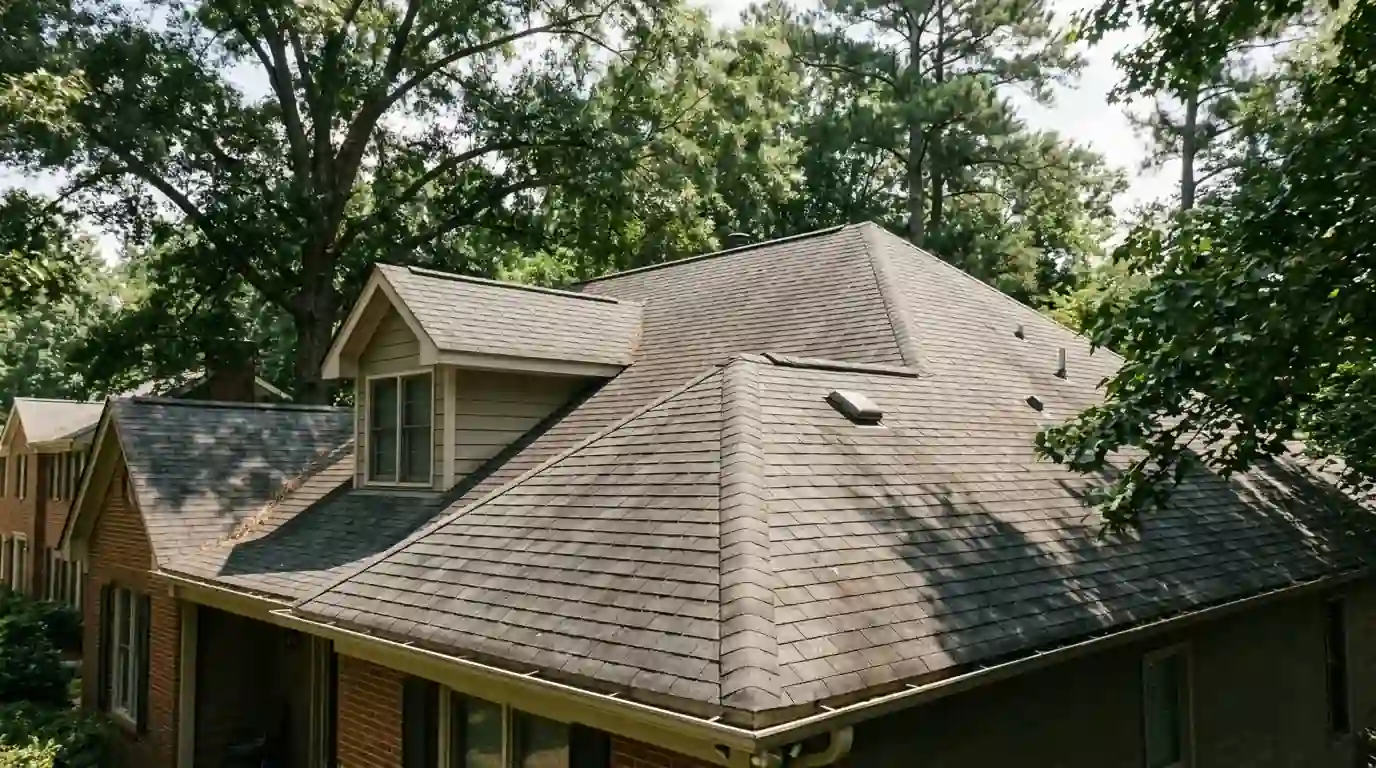
In Georgia, a 3-tab asphalt roof usually lasts about 15 to 20 years and architectural shingles about 20 to 28. Standing seam metal often runs 40 to 60 years, synthetic slate 40 to 50, and natural slate or clay tile can go far longer. Heat, humidity, poor attic ventilation, shade and storms shorten every one of those numbers, sometimes by a decade or more.
Why Georgia roofs age faster than the label says
The lifespan printed on a shingle bundle is a warranty term, not a promise of how long the roof will last on your house. Those numbers assume good ventilation and moderate weather. Metro Atlanta asks more of a roof. Shingles on a south-facing slope can climb well past 150 degrees on a July afternoon, then cool quickly when a thunderstorm rolls through. That daily swing expands and shrinks the shingles over and over, while UV slowly dries out the asphalt that keeps them flexible. Over twenty summers, that adds up to brittle, cupped shingles.
Humidity adds a second kind of wear. Moisture that never fully dries feeds algae, moss and lichen, and it softens decking around nails and seams. Add spring hail, summer wind from fast storms and the occasional winter ice storm, and most Atlanta roofs reach the end of their useful life well before the number on the wrapper. That does not mean every roof here fails early. A well-built roof on a ventilated attic, kept clean and checked after storms, can reach the top of its range. A neglected one rarely does.
Typical lifespans by material in Georgia
These are the ranges we see in real life around metro Atlanta, not the figures on a brochure. Your roof may land higher or lower based on how it was installed, which way it faces, how shaded it is and how well the attic breathes. Use them as a planning guide when you are buying a house, budgeting for a replacement or deciding whether a repair is worth it. If your roof is near the end of its range, a small leak is often a sign of more to come rather than a one-time fix.
- 3-tab asphalt shingles. About 15 to 20 years. The thin single layer dries out and loses granules faster in our sun, and tabs tend to lift in strong summer wind.
- Architectural shingles. About 20 to 28 years. The thicker laminated build handles heat and wind better, which is why it is the standard choice on most Atlanta homes now.
- Standing seam metal. About 40 to 60 years. Paint finishes may chalk over time, and fasteners, sealants and pipe boots need checks long before the panels wear out.
- Synthetic slate. About 40 to 50 years for quality composite products, assuming good installation and proper fastening on the steep slopes where they are commonly used.
- Natural slate and clay tile. Often 75 years or more. The stone or tile outlasts its flashing and nails, which usually need attention long before the roof itself does.
- Flat and low-slope roofs. About 15 to 25 years for TPO, EPDM and modified bitumen, and shorter where water ponds or foot traffic from HVAC service is heavy.
What shortens a roof's life the most
Poor attic ventilation is the quiet roof killer we find most often. Many Atlanta houses built from the 1960s through the 1990s have too little intake at the soffits, painted-over vents or a mix of ridge vent and box vents that work against each other. Hot, damp air gets trapped under the decking and bakes the shingles from below while the sun cooks them from above. Signs include rippled shingles, a stuffy attic in summer, rusted nails poking through the decking and frost on the nail tips during cold winter mornings.
Trees come next. Branches rubbing a roof grind off granules, shade keeps slopes damp, and pine straw and leaves fill valleys and gutters so water backs up under the shingle edges. Bad installation also costs years: high nailing, missing starter strips, reused flashing and no drip edge all lead to early wind damage and leaks. Finally, storm damage that is never repaired keeps doing harm. A few bruised or lifted shingles after a spring hailstorm can let water reach the decking for years before a stain finally shows on a ceiling.
Signs your roof is near the end
Age alone does not decide a replacement, so we look at the roof itself. From the yard, watch for curling or cupped shingles, bald patches where granules are gone, and tabs that are missing after a windy night. In the gutters, a steady pile of granules after every rain means the shingles are shedding their protection. In the attic, look for daylight around nails, water stains on the underside of the decking or damp insulation. Any one of these can be a repair. Several at once usually means the roof is close to done.
We also ask how many repairs the roof has needed lately. One leak around a pipe boot on a fifteen-year-old roof is normal wear on a part that often fails first. Three leaks in three different places in two years tells a different story. At that point, money spent on repairs is often better saved toward a new roof. When we inspect, we give you a realistic estimate of how many years are left so you can plan, not just a yes or no on replacement today. That helps you budget ahead.
How to get the most years out of your roof
You cannot change the weather, but you can change how hard it hits your roof. Most of what extends a roof's life around Atlanta is simple, inexpensive upkeep done on a schedule rather than after a leak. We suggest a roof inspection every couple of years and after any hail or major wind event, plus a look in the attic each summer. Small fixes like resealing a flashing seam or replacing a cracked pipe boot cost a fraction of the water damage they prevent, and they keep a sound roof sound.
- Balance attic ventilation. Pair clear soffit intake with ridge or roof vents so hot, wet air leaves the attic instead of cooking the shingles from below all summer.
- Clean gutters twice a year. Late spring after pollen and pine straw, and late fall after the leaves come down, so water keeps moving off the roof edge.
- Trim trees and act on storms. Keep branches off the roof and have it checked after hail, since small storm damage left alone often becomes a big leak later.