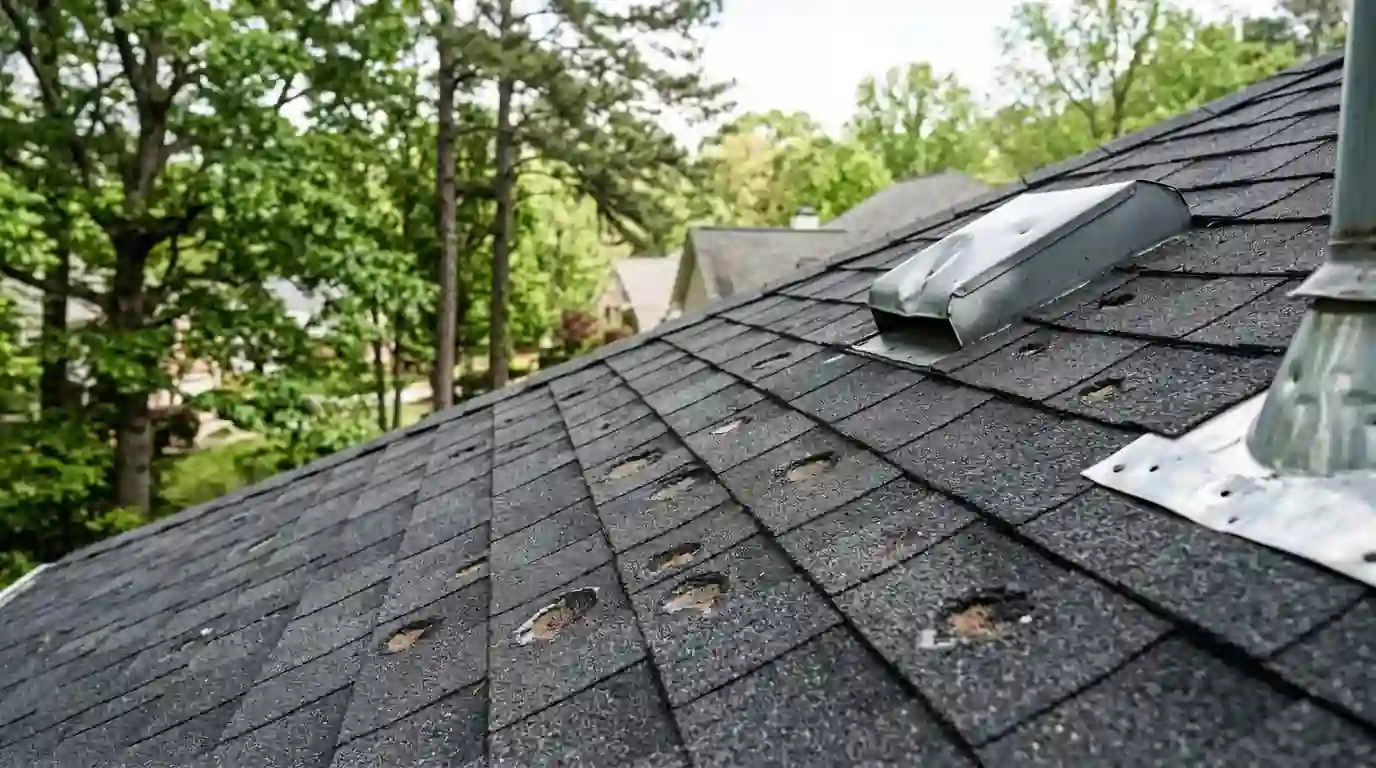
Hail damage on an asphalt roof usually shows up as dark, round spots where granules were knocked loose, soft bruises that give under your thumb, and cracked or split shingle edges. The easiest clues are on the ground floor: dents in gutters, downspouts, AC fins and metal vents. If you see those after a spring storm, take photos from the yard and call us for a roof inspection before filing a claim.
Why spring hail hits Atlanta roofs hard
Most of the hail we see in metro Atlanta falls between March and May, when warm, wet Gulf air runs into cold fronts sliding down from the northwest. Those storms build fast over the afternoon and can drop a band of hail across Cobb, Fulton, Gwinnett or Cherokee in ten minutes, then leave the next subdivision untouched. That patchiness is why one street gets new roofs and the street behind it does not. Stones under about three quarters of an inch rarely hurt a healthy shingle. Once hail reaches an inch or larger, or comes in on a strong wind, asphalt shingles start losing granules and cracking.
Age matters as much as hail size. A roof that has baked through fifteen Georgia summers has shingles that are drier and more brittle than they were on day one, so the same storm can bruise an older roof and barely mark a newer one. Shade from oaks and pines also keeps some slopes damp and soft while others stay hot and stiff. That is why we never judge a roof by one side. The south and west slopes often take the worst of a spring storm because that is where the wind drove the stones, but we check every plane before saying what happened.
Granule loss, bruises and cracked mats
Asphalt shingles are a fiberglass mat soaked in asphalt and topped with colored ceramic granules. The granules block UV, and once they are gone the asphalt under them dries out much faster in our sun. Hail knocks granules off in round or oval spots, usually in a random scatter rather than a neat line. Wear from age looks different: it shows up evenly, along the drip edge or under a downspout that dumps onto a lower roof. Hail hits also leave telltale signs inside the shingle that only show up when someone presses on it or lifts a tab.
- Exposed black spots. Round marks where the granules are gone and the dark asphalt shows through, often shiny right after the storm and scattered with no pattern across the slope.
- Bruises. Soft spots that give under light thumb pressure, like a bruised apple. The mat underneath is crushed even though the surface may look almost normal from the ground.
- Cracked or split tabs. Fractures radiating from an impact point or splits along the edge of a tab, which let water reach the nail line and decking during the next heavy rain.
Dents in gutters, vents and other soft metal
You do not need a ladder to find the best early evidence. Soft metal records hail better than shingles do, and most of it is reachable from the yard or a deck. Look at the tops of aluminum gutters and the face of downspouts for small round dents. Check the box vents, turbine vents and ridge vent caps you can see from the street with binoculars. Look at the fins on your outdoor AC condenser, painted metal on mailboxes and light fixtures, and window screens on the side the storm came from. Dents spaced across all of those surfaces point to hail large enough to matter.
Soft metal also tells us the size and direction of the hail, which helps when we compare it to the roof. A dent the size of a quarter on a downspout usually lines up with bruising on the shingles above it. Dents only on the west side of the house tell us which slopes to study first. Keep in mind that dented metal alone does not mean your roof needs replacing. Gutters and vents can often be repaired or swapped on their own. The shingles tell us if you are looking at a repair, a partial claim or a full replacement.
What to photograph after the storm
Good photos taken the same day make every later conversation easier, with us and with your insurance adjuster. Use your phone, keep the date and location data on, and stay on the ground. Wet shingles after a storm are slick as ice and we do not want anyone on a roof or a tall ladder. Take wide shots that show the whole side of the house first, then move in close on damage. If you still have hailstones in the yard, photograph a few next to a coin or a tape measure before they melt.
- Hailstones with a size reference. A quarter, a golf ball or a tape measure next to the stones gives a clear record of size, which adjusters weigh heavily when deciding what the storm could have done.
- Gutters, downspouts and vents. Close shots of dents in soft metal, plus a wider photo showing where each piece sits on the house, so the direction of the storm is easy to read later.
- Cars, screens and AC fins. Dented car hoods, torn screens and flattened condenser fins back up the roof findings and show the hail was large enough to damage harder surfaces.
- Ceilings and the attic. Any new stains, drips or damp insulation, photographed with a flashlight and dated, since interior leaks can show up days after the hail itself.
When to call and how claims usually go
Call us soon after the storm if you see dents on metal, granules piling up at the bottom of downspouts, or any new ceiling stain. Most homeowner policies in Georgia set a deadline for reporting storm damage, and the clock usually starts on the storm date, not the day you notice a leak. Read your policy or ask your agent what yours says. Waiting a season also lets bruised shingles crack through and start leaking, which can turn a clean hail claim into an argument about wear and maintenance. Early calls are simply easier.
When we inspect, we walk every slope, mark hits with chalk, count them in test squares, check the soft metals and look in the attic if you let us. You get photos and a plain description of what we found, including when we think the damage is too light to be worth a claim. If it is worth filing, we can meet the adjuster on the roof and point out what we marked. After a big hail day, be wary of out-of-state crews knocking on doors. Call (470) 876-1496 any time, day or night, and we will set up a visit.