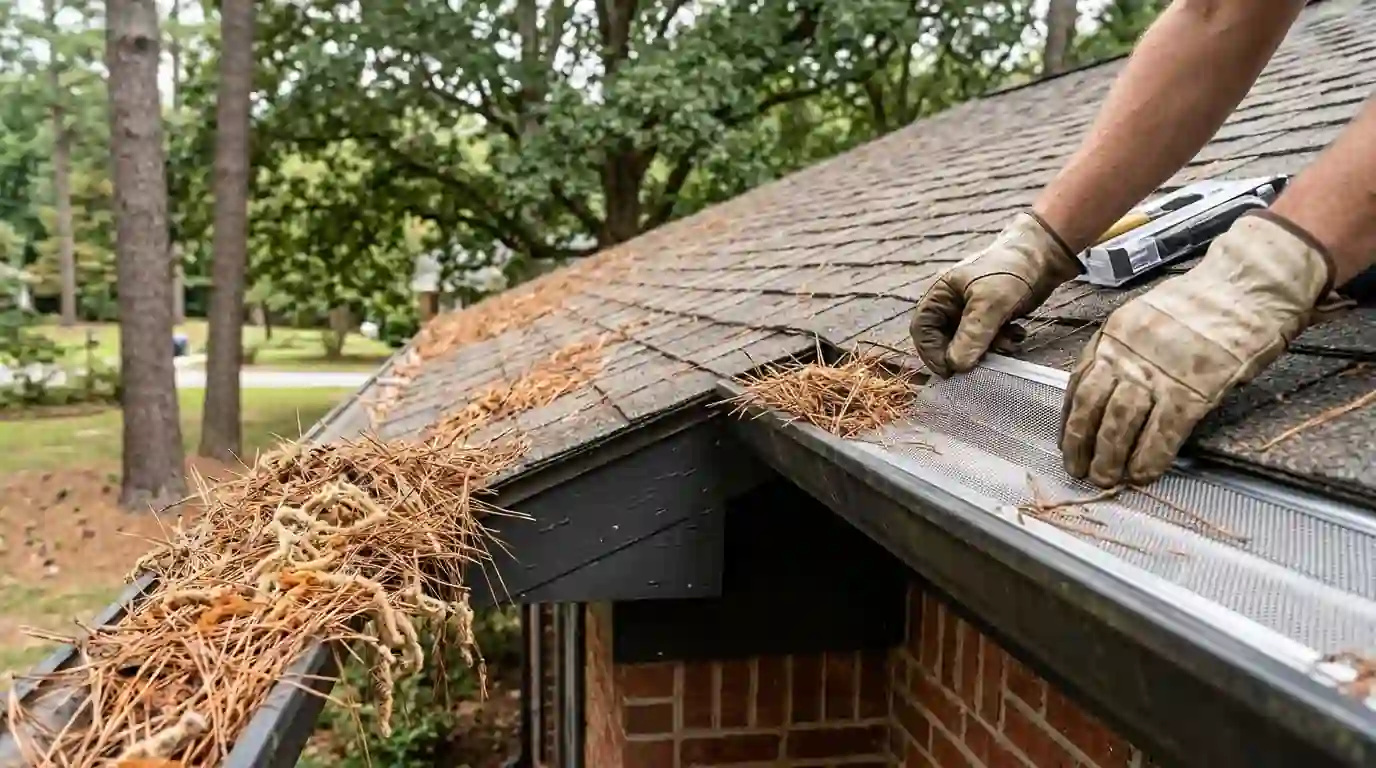
For homes under pines, stainless micro-mesh guards usually work best, because needles cannot slip through the fine mesh. Plain screens and foam inserts tend to trap needles, and reverse curve covers can let them ride into the slot. No guard is truly maintenance-light under heavy trees, but good micro-mesh cuts gutter cleaning from several times a year to an occasional brush-off from the ground or a ladder.
Why Atlanta gutters clog so fast
Many metro neighborhoods sit under a mix of tall loblolly pines, water oaks and red oaks, and each tree drops something different. Pines shed long needles through much of the year. Oaks drop leaves in late fall, then catkins, often called tassels, in early spring, along with acorns and a heavy coat of yellow pollen. Put all of that together and an open gutter on a wooded lot in Marietta or Dunwoody can fill in a matter of weeks. Homes with several big trees close to the eaves often need cleaning three or four times a year without guards, and that means a lot of time on a ladder.
A clogged gutter does more than overflow. Water spills behind the gutter and rots fascia boards, soaks the soil next to the foundation and splashes red clay up onto siding. In winter, standing water in a packed gutter adds weight that pulls hangers loose. Needles packed into downspouts are the worst, because the gutter can look clear from the yard while the outlet is completely blocked and water backs up out of sight. By the time you notice, water may already be running down the inside of the wall or pooling against the foundation.
The four main types of gutter guards
Gutter guards fall into a few broad families, and the differences matter more under pines than under any other tree. The key question is the size of the openings. Anything larger than a pine needle's width will let needles slide in point first, where they lodge and start building a mat. Anything that sits flat with no pitch tends to hold debris on top instead of letting it blow off. Material matters too. Thin plastic warps and cracks in Georgia sun within a few years, while aluminum frames and stainless mesh hold their shape far longer.
Below is a quick look at what each type does well and what tends to get past it. These are general patterns we see on Atlanta homes, and results vary with roof pitch, how many trees overhang the house and how well the guard is installed and tucked under the shingles. A cheap guard installed well can beat an expensive one installed poorly, but under heavy pines the type of opening still sets the ceiling on how well any guard can perform. Here is the short version of each, with the needle problem in mind.
- Screens and perforated covers. Plastic or aluminum panels with fairly large holes. Inexpensive and easy to install, but pine needles slip right through and lodge, so they help with leaves more than needles.
- Micro-mesh. A fine stainless steel mesh over a rigid frame. Openings are small enough to stop needles and most grit, which makes this the strongest option for wooded Atlanta lots.
- Reverse curve covers. A solid hood that bends water around a curved nose into the gutter. Leaves fall off well, but needles can follow the water into the slot and build up inside.
- Foam and brush inserts. Foam blocks or bristle brushes that sit inside the gutter. Cheap and simple, but needles stick into them, and the foam can hold debris and grow seedlings.
What clogs each type
No guard is perfect, and it helps to know how each one fails before you buy. Screens let needles through and fill up underneath, so you end up removing the screen to clean. Foam inserts trap needles like a pin cushion and eventually break down in the sun. Reverse curve hoods work well with broad oak leaves but can let needles ride the water film into the gutter, where they pack the opening. Those hoods are also hard to clean once needles get inside, because the narrow slot gives you little room to reach in.
Micro-mesh is the most reliable under pines, but even it has a weak spot: oak tassels and pollen can lie flat on top of the mesh and slow water during a heavy rain. On most roofs that layer dries and blows off. Under heavy oaks, an occasional brush with a soft broom on a pole keeps it clear. That is a far easier job than scooping wet needles out of an open gutter, and it can usually be done from the ground on a one-story home. Two-story homes and steep lots are better left to a roofer with the right ladders.
- Pine needles. Slip through screens, stick in foam and can enter reverse curve slots. Fine micro-mesh is usually the only type that keeps them out reliably.
- Oak tassels and pollen. Mat on top of almost every guard in spring. Micro-mesh set at a slight pitch sheds them better than flat guards once the layer dries out.
Typical cost ranges
Gutter guard prices depend on the type, the height of the house and the condition of the gutters underneath. For typical Atlanta-area homes, installed prices often fall in these rough ranges per linear foot: basic screens about $3.15 to $6.40, foam or brush inserts about $2.85 to $5.70, quality micro-mesh about $9.35 to $17.80, and reverse curve systems about $11.20 to $21.60. These are typical Atlanta-area ranges that depend on the roof and gutters, not a quote. Two-story homes, steep lots and a lot of inside and outside corners push prices toward the top of each range, and gutter repairs before installation are priced separately.
Spend the money on the gutters first if they need it. Guards installed on sagging, leaking or undersized gutters will not fix the real problem. On many wooded lots we recommend cleaning, resloping and resealing the existing gutters, or replacing them with seamless gutters and larger downspouts, before adding micro-mesh. Larger downspouts clog less, which matters when needles do find a way in. A three-by-four inch downspout carries noticeably more water than the standard size and is much harder to clog with needles, acorns and the small twigs that come down in summer storms.
Getting the most from your gutter guards
Installation makes as much difference as the product. Guards should slide under the first course of shingles or attach at the drip edge without lifting shingles or breaking seal strips, and they need a slight pitch so debris can blow off. They should be screwed down, not just snapped on, so summer storms do not peel them loose. Downspout openings need extra attention, since that is where most clogs start. A small strainer or a leaf catcher at the downspout can help on very heavy lots, as long as someone empties it.
Plan on a quick check twice a year, usually in late fall after the needle drop and again after spring pollen and tassels. It takes only a few minutes. Look from the ground with binoculars or from a ladder for mats on top of the guards and water spilling over during rain. If your gutters keep overflowing under pines, call us any time and we will look at the gutters, guards and roof edge together and tell you what will actually help, in plain terms, before any work is done.