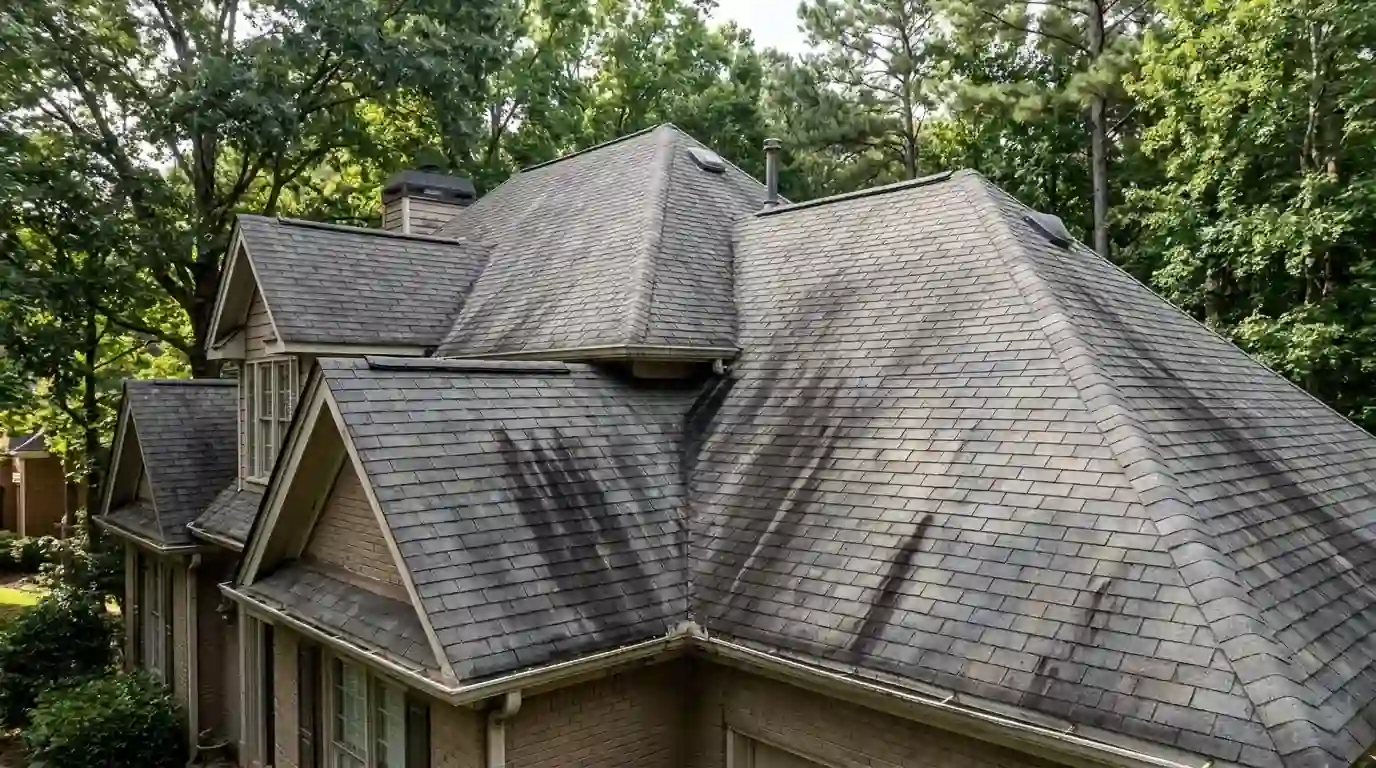
The black streaks running down so many Georgia roofs are usually Gloeocapsa magma, a blue-green algae that feeds on the limestone filler in asphalt shingles and thrives in our heat and humidity. It is mostly cosmetic at first, but it holds moisture and spreads. A low-pressure soft wash removes it safely. Zinc or copper strips and algae-resistant shingles help keep it from coming back.
What the black streaks actually are
Gloeocapsa magma is a cyanobacteria, often called blue-green algae, that lives almost everywhere in the humid Southeast. Spores ride the wind and land on roofs, where they feed on the crushed limestone used as filler in many asphalt shingles. As the colony grows, it builds a dark outer coating to shield itself from UV light. That coating is what you see: streaks that start near the top of a slope and run downhill as rain carries the algae along. The streaks often look worse on lighter gray and tan shingles, though they show up on every color.
It helps to know what it is not. Black streaks are not usually soot, mildew from the attic or a failing shingle. Moss is green, raised and spongy, and tends to grow in thick shady patches on the north side. Lichen looks like crusty gray-green or pale circles stuck tight to the granules, and it grips hard enough to pull granules off when it is scraped. Algae is flat and dark and wipes off as a smear. Many older Atlanta roofs have all three, and each one calls for a slightly different cleaning plan.
Why Georgia roofs streak so badly
Algae needs moisture, warmth and shade, and metro Atlanta supplies all three most of the year. Our summers stay humid for months, morning dew sits on the shingles, and the tree canopy over neighborhoods like Decatur, Smyrna and Roswell keeps many roofs shaded well into the afternoon. North-facing slopes dry slowest and almost always streak first. Spores also spread from roof to roof down a street, which is why whole subdivisions seem to turn dark around the same time once the shingles reach eight or ten years old. A few things make it worse.
- Shade and tree cover. Oaks, pines and maples overhanging a roof slow drying after rain and dew, and drop leaves and pollen that hold even more moisture against the shingles.
- North-facing slopes. These planes get the least direct sun, stay damp the longest and are usually the first place streaks appear on an Atlanta house.
- Gutters and debris. Clogged gutters and piles of pine straw in valleys keep the lower edge of the roof wet, giving algae a steady, damp place to grow and spread.
Soft washing versus pressure washing
Never pressure wash an asphalt roof. A pressure washer strong enough to blast algae off will also strip granules, drive water up under the shingle laps and loosen the seal strips that hold tabs down in wind. You can take years off a roof in one afternoon, and many shingle manufacturers say in their warranty terms that pressure washing is not allowed. The streaks may look gone, but the roof underneath is now more exposed to the sun and more likely to leak. We see this every summer on roofs that were otherwise in good shape.
Soft washing is the method shingle makers and the roofing trade point to. A low-pressure pump applies a diluted cleaning mix, typically sodium hypochlorite with a surfactant so it clings, and lets it sit long enough to kill the algae. The roof is rinsed gently or left for rain to finish the work. Plants below get watered before and after, and gutters and downspouts are flushed. Results show the same day on algae, while lichen can take a few weeks of rain to fade. A typical soft wash on an Atlanta house runs $385 to $1,140 based on size and pitch.
Zinc and copper strips
Zinc and copper both stop algae from growing. When rain washes over a strip of either metal near the ridge, it carries a small amount of metal ions down the slope, and those ions keep new colonies from taking hold. Strips are installed just below the ridge cap on each slope, tucked under a course of shingles and nailed so only a narrow edge shows. On a clean roof they slow the return of streaks for years. They will not clean a roof that is already dark, so they belong after a soft wash, not instead of one.
Copper is more effective and lasts longer, but costs more. Zinc is cheaper and works well, though it can leave a light chalky look over time. Either way, the protection fades the farther you get from the strip, so a long slope may still streak near the gutter. A single run of strips usually protects roughly the top 10 to 15 feet below it. Adding strips during a roof replacement costs very little. On an existing roof, we nail them carefully under the cap course so the shingles stay sealed and the new nails stay covered.
Algae-resistant shingles and keeping streaks away
If your roof is near the end of its life anyway, algae-resistant shingles are the long-term answer. GAF, Owens Corning, CertainTeed, Atlas and others mix copper-coated granules into many of their shingle lines, and the copper works the same way the strips do, only spread across every shingle. Most of these lines carry a separate manufacturer warranty against algae staining for a set number of years. On a shaded lot in Atlanta, we treat algae resistance as a standard feature to ask for rather than an upgrade, and the price difference is usually small.
- Trim back branches. Keep limbs six to ten feet off the roof so sun and moving air can dry the shingles faster after rain and overnight dew.
- Keep gutters and valleys clear. Pine straw and leaves packed in valleys and gutters hold water against the roof edge and feed new growth all season long.
- Clean early. Soft washing a roof when streaks first appear is quicker and easier on the shingles than waiting until the whole slope turns black.