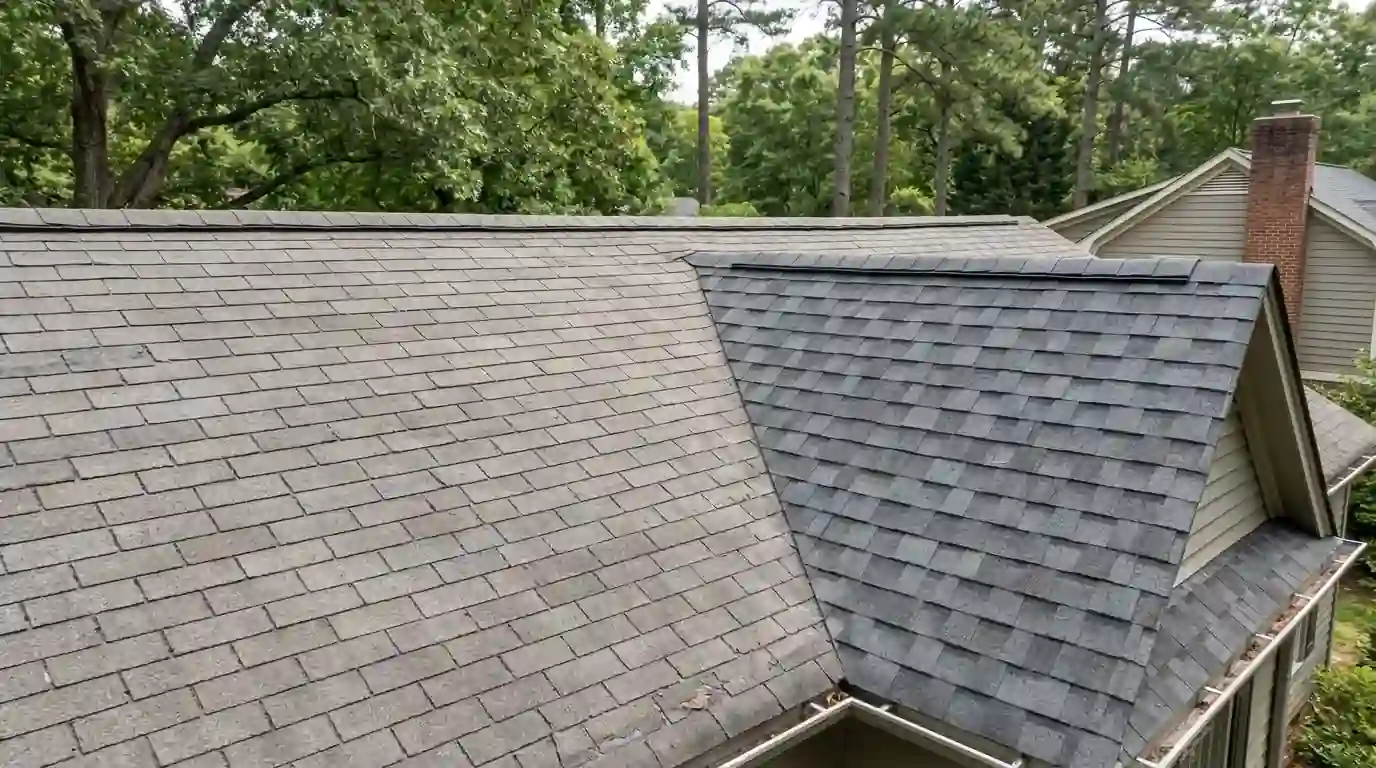
Architectural shingles are thicker, laminated shingles with a dimensional, shadowed look. They are usually wind-rated to 110 or 130 mph and last about 20 to 28 years in Georgia. 3-tab shingles are a single flat layer, often wind-rated to 60 or 70 mph, and last closer to 15 to 20 years. Architectural typically costs about 10 to 20 percent more installed, which is why it is now the default choice.
How each shingle is built
Both types start the same way: a fiberglass mat coated in asphalt and topped with ceramic granules. The difference is in the layers. A 3-tab shingle is one flat sheet with two cutouts along the bottom edge, which makes it look like three separate tabs once it is on the roof. Every tab is the same size, so the finished roof has a flat, uniform, brick-like pattern. Architectural shingles, also called dimensional or laminated shingles, bond two or more layers together, with the lower layer showing through cut gaps in the top layer.
That extra layer changes nearly everything. Architectural shingles are heavier per square, usually running from about 250 to well over 350 pounds, against roughly 210 to 240 for a typical 3-tab. They also tend to have a wider nailing zone and a stronger seal strip. In practical terms, the shingle sits flatter on the deck, resists tearing when wind catches an edge and hides small dips or waves in older decking much better. On many 1960s and 1970s ranch homes around Atlanta, that last point alone makes a visible difference in how the finished roof looks.
Wind resistance and storm performance
Wind is where the gap shows up in Atlanta. Summer thunderstorms and the occasional remnant of a Gulf hurricane bring gusts that lift shingle edges, break the seal strip and peel tabs back. A standard 3-tab shingle is usually wind-rated around 60 mph, or about 70 with extra nails. Most architectural lines are wind-rated to 110 mph with standard nailing and 130 mph with high-wind nailing and the right starter strip. Those wind numbers from manufacturers assume proper installation, so the nailing pattern matters as much as the product on the pallet. Six nails per shingle, set in the marked zone, is what we use on exposed Atlanta ridges and hilltops.
- Seal strip. Architectural shingles usually carry a wider, stronger adhesive strip that bonds to the course below once the Georgia sun warms it, which keeps edges down in gusts.
- Nailing zone. A wider nailing area on most architectural shingles makes it easier for roofers to hit the right spot, and missed or high nails are where most wind failures start.
- Hail and impact. Thicker laminated shingles handle small hail better than thin 3-tabs. For larger hail, Class 4 impact-resistant architectural lines are another clear step up.
Looks and curb appeal
Curb appeal is what most homeowners notice first. A 3-tab roof has crisp, even lines and a flat look that suits some mid-century homes and simple outbuildings. Architectural shingles have random tab widths and a shadow line that gives the roof depth, closer to the look of wood shake or slate from the street. They also come in more colors and blends, including the weathered wood, charcoal and driftwood tones that are common on newer homes across Alpharetta, Johns Creek and Peachtree City. Most lines also offer algae-resistant granules, which helps on shaded Georgia lots where black streaks show up fast.
Architectural shingles also hide flaws. Uneven decking, slight sags and repairs over the years all show through a flat 3-tab roof as ripples and shadows. The random pattern of a dimensional shingle breaks up those lines so the eye does not catch them. That matters to buyers. When a house goes on the market, a roof that looks newer and more substantial in listing photos helps. Some homeowner associations around the metro also call for dimensional shingles in their design guidelines, so check your HOA rules before choosing either one.
The real cost gap
The price gap between the two is smaller than most people expect. On a typical metro Atlanta replacement, architectural shingles usually add about 10 to 20 percent to the installed cost, since tear-off, underlayment, flashing and labor are nearly the same either way. For a 25-square roof, that often works out to roughly $1,180 to $2,740 more for architectural. Spread across an extra five to eight years of life, architectural shingles usually cost less per year than 3-tab, before you even count lower wind repair bills. Ask for both prices on the same estimate so the gap is easy to see.
There are still cases where 3-tab makes sense. A detached garage, a shed or a small porch roof that only needs to last a few more years can be a fine place for the cheaper product. Some homeowners with 3-tab roofs also need a small repair on an otherwise sound roof and want the new shingles to blend in. For a full replacement on a house you live in, though, we almost always recommend architectural. The upgrade costs little more and holds up far better in our heat, wind and summer storms.
Why 3-tab is rarely installed now
Walk any Atlanta subdivision built in the last twenty years and you will see almost nothing but architectural shingles. Builders switched because buyers wanted the look, and homeowners got tired of replacing blown-off tabs after windy storms. Manufacturers followed demand. Several major brands have trimmed their 3-tab offerings down to a handful of products in a few colors, and supply houses stock far less of it than they used to. That shrinking supply is now a real problem for anyone trying to patch an older 3-tab roof, and it shapes the choices below.
- Fewer colors. With fewer 3-tab products on the shelf, finding a close color for an older roof gets harder every year, so patches often stand out from the street.
- Shorter manufacturer coverage. Most 3-tab lines carry shorter manufacturer warranties and lower wind limits than architectural shingles, which matters if you plan to stay in the house.
- Storm damage replacements. When a 3-tab roof has wide storm damage and the color can no longer be found, a full replacement with architectural shingles is often the practical path.